

The Psychic Entity Continuum
A Taxonomy of Spirits, Demons and the Strange In-Between

In parts therapy or Internal Family Systems Therapy (IFS), one imaginatively interacts with emotions, thoughts, and addictive patterns as if they’re semi-independent and can speak for themselves. This type of imaginative work helps one understand the psychodynamics of one’s mind and is a fairly standard practice. However, it can get weird.
The psychotherapist Robert Falconer has faced cases where the patient apparently has parts that are foreign to the patient and not part of them.
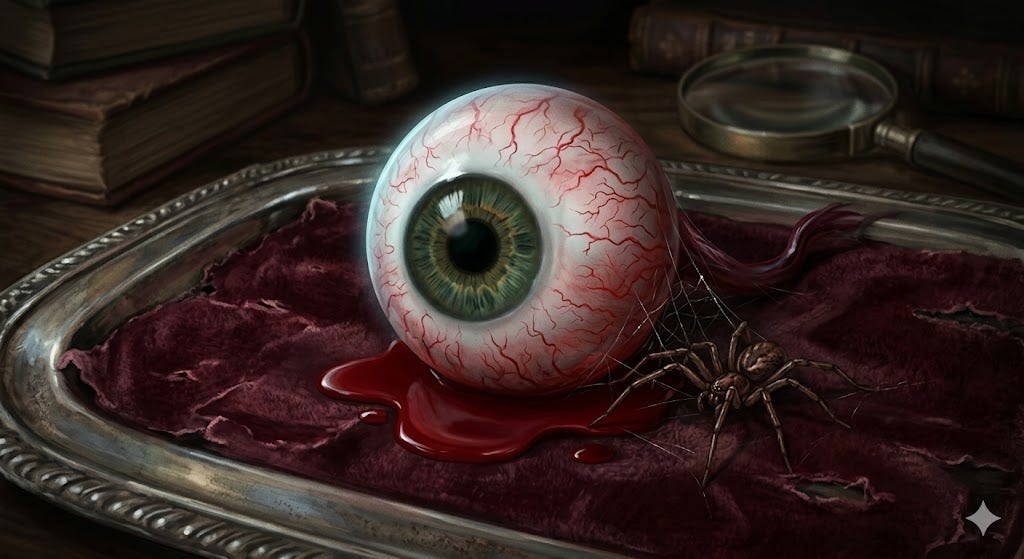
These rare parts are characterised by insulting the patient, tormenting the patient, and causing all kinds of mental and even psychosomatic harm. They might also, for example, be associated with nasty visual imagery, like that of bleeding eyeballs and spiders.
Sometimes these “foreign” parts would themselves say explicitly that they were not a part of the person. Other times they would at first taunt and say they were a part of the person, and only with a bit (or a lot) of interrogation would they admit that they’re not a part of the person.
These cases are admittedly rare - Robert Falconer stresses this point. It also only seems to occur in people who have typically undergone a lot of trauma and abuse throughout their lives. So perhaps we should dismiss this as a peculiar oddity and nothing more.
Indeed, it may be seen as a kind of psychotherapeutic heresy to label psychic parts as foreign to your mind because, well, what does that even mean? How would you do therapy if there is someone or something afflicting a person that is not part of them?
Nevertheless, Mr. Falconer is pragmatic. In the rare cases it’s warranted, he believes it’s better to admit that a part can be foreign to the patient. Because once the part is found to be foreign, he can then help. For example, by leading them through what can only be described as a kind of mini exorcism. A ritual that included having compassion for the foreign part, but firmly telling it that it must leave the person, in addition to using visualisation techniques like imaginatively removing the part in a ball of light.
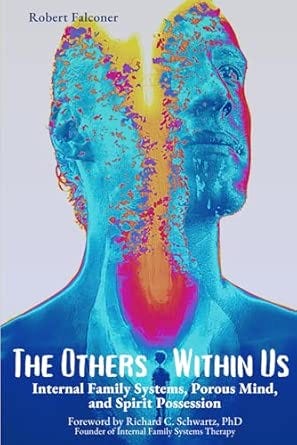
Robert Falconer put to the side metaphysical questions of what these things really are, instead advocating the pragmatic stance that, if it helped the patient, then there might be truth to it. But I do want to tackle such metaphysical questions, especially because I don’t think these foreign entities are necessarily as rare as we might think.
There is something about these inter-categorical, not-quite-us but not-quite-completely-other entities that tells us a lot about the nature of the mind, and of the spiritual realities which can afflict it. I believe investigating these strange cases may prove metaphysically fruitful.
The Metaphysics of Demons
Is what Robert Falconer is dealing with a demon? Of course, using the word “demon” might evoke scenes from The Exorcist of levitations or people speaking foreign languages they couldn’t possibly know. However, not every case of demonic possession is necessarily so extreme.
For example, I talked with the psychiatrist Richard Gallagher who has worked with exorcists. He lays out how sometimes there are full-on demonic possessions, but that only happens in rare cases when people have actively invoked demons and explicitly acknowledged the spiritual side. However, what may be more common is demonic “oppression,” a lesser affliction than full possession whereby you are not fully possessed by a demon but only partially so.
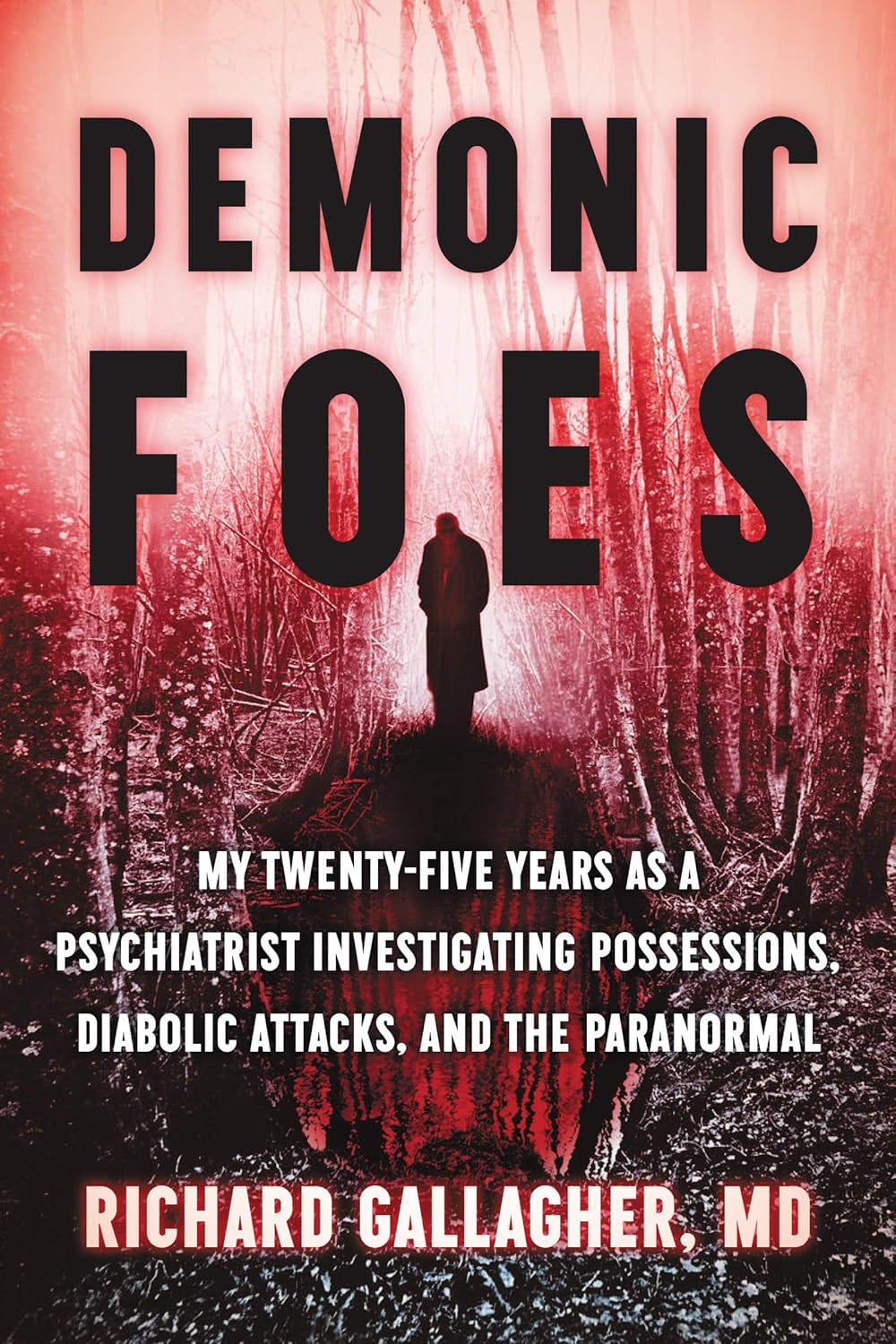
Richard Gallagher also says one needs to be really careful and distinguish between biological mental illness and the spiritual issue of demonic possession, which I think is appropriate, because we don’t want to confuse the two.
However, saying that some things are mental illness and some are spiritual, with a hard categorical line between them, is not necessarily helpful either. There seems to be a continuum between mental illness and spiritual illness. Indeed, neuroscience isn’t always so conventional, but has a plethora of strange and bizarre cases we hardly understand.
The Metaphysics of Brains
Neuroscience can be strange. There is this great paper by Michael Levin and Karina Koffman titled "Robustness of the Mind-Body Interface: Case Studies of Unconventional Information Flow in the Multiscale Living Architecture." They argue we don't understand the basics of how the brain works, how memories work, or the relationship between the physical brain and cognition and consciousness. This paper tries to synthesize a host of weird anomalies in documented neuroscience cases that standard theories of the brain can't explain.
One of my favourite case studies was of a woman who suddenly heard a voice telling her she had cancer, and the voice was correct, and so she could take action in the nick of time to remove it. From the paper:
“In one bizarre case, there was a report of a cancer diagnosis made by a woman’s hallucinatory voices (Azuonye 1997). Hallucinatory voices could occur in healthy patients, such as those grieving the death of a loved one, or psychiatric patients, such as schizophrenics. In this case, a woman in her thirties from London experienced voices in her mind which spoke and pressured her to go get diagnostic scans for her brain tumor. She had no prior neurological signs or symptoms so there was no clear justification to request diagnostic imaging. Yet, once the doctor conceded to the voices’ instruction and ordered a head CT scan, a brain tumor was indeed identified. After the tumor was removed, the voices said goodbye and never returned to the woman again (Azuonye 1997, Bobrow 2003).”
How does neuroscience explain these kinds of cases?
In addition to a case like this, there is research on people with only one hemisphere, or a removed cerebral cortex, or a brain and head that are too small, yet cases still occur where people have normal lives and brain function. This is strange. As they say in the paper, “the relationship between brain size and cognition cannot be scaled that easily.”
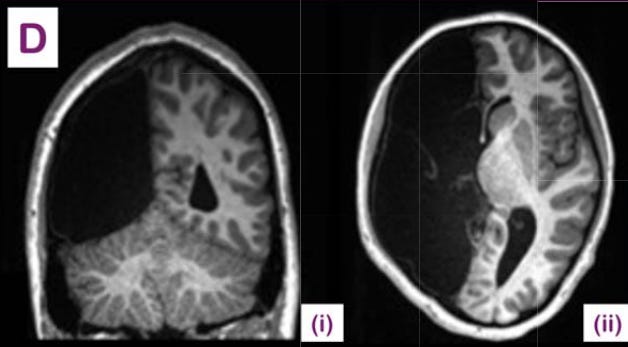
There are also cases of terminal lucidity, whereby people who have had serious neurodegenerative disorders suddenly become lucid just before they die: for example, a young man with metastatic lung cancer whose tumor had replaced so much brain matter that he couldn’t speak or move — yet in the hours before his death he woke up, conversed with his family, said his goodbyes, and then died shortly after. Or a 91-year-old woman who had been paralyzed with a completely frozen expression after two consecutive strokes — yet right before death she sat up in bed, raised her arms, and called out her husband’s name.
There are a variety of exceptional neuroscience cases. Michael Levin’s ideas more broadly are that the brain isn’t creating all of its own consciousness, but rather accessing minds that exist and can be tapped into when you create the right brain interface. So perhaps it’s an ongoing battle to maintain our standard consciousness, and foreign outside influences to our brain are potentially able to burst in, under the right conditions.
A Science of Psychic Entities
Coming back to psychic entities. A neuroscience theory that I think comes closest to understanding this strange phenomena of experiencing entities that are not us, is Ben Alderson-Day’s work on presence. He argues that our brains have the capacity to experience the presence of other beings. We can do this because we first have the presence of our own bodies in 3D space and are constantly simulating this felt sense in real time. Then this brain machinery can then be extended outwards to simulate other beings. Often, this sense of presence of an other happens in very stressful situations.
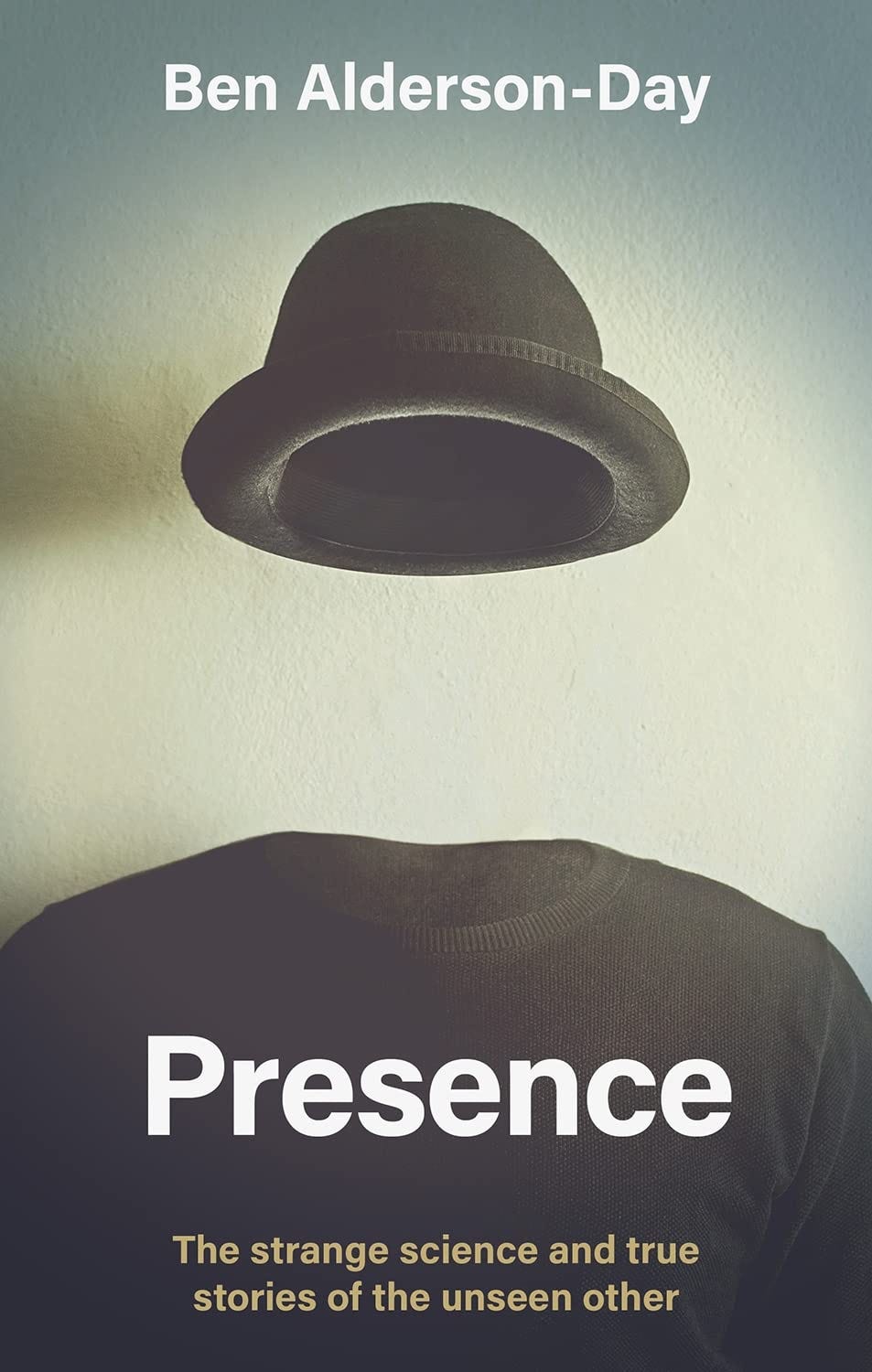
For example, during Shackleton’s Antarctic expeditions in the early 20th century, the term the “third man effect” was coined when a group were trekking in terrible conditions in order to save their crew, and during it, it felt like there was another presence with them. It gave them comfort at the time, even though it was a bit bizarre to think about afterwards.
Ben Alderson-Day’s work is about this raw capacity for presence that we have. It doesn’t even need to be visual or auditory. In difficult circumstances, people seem to consistently have these strange experiences of a felt presence of an other with them. Sometimes the other can give you invaluable information. It doesn’t have to be the mentally ill that experience presence, but even normal people, under the right conditions.
A Taxonomy of Psychic Entities
We have an abundance of strange cases, but not really a way to think about where and how they relate to each other. We see Robert Falconer’s seemingly foreign psychic entities, strange neuroscience cases, and alleged cases of full-scale demonic possession. How do we taxonomize all of these strange cases into a coherent framework?
I think we need to realise that there are two distinct but interrelated axes along which foreign mental entities can influence our minds.
On the one hand is the degree of mental influence of something outside of us. This is the more scientific side of the story, whereby we need to do work on the nature of brains, how cognition and memory work, and how we can be taken over by other minds.
On the other hand, we should separate this conceptually from spiritual influence, the genuinely moral dimension of reality which dictates the kind of mind or foreign mental entity that afflicts you.
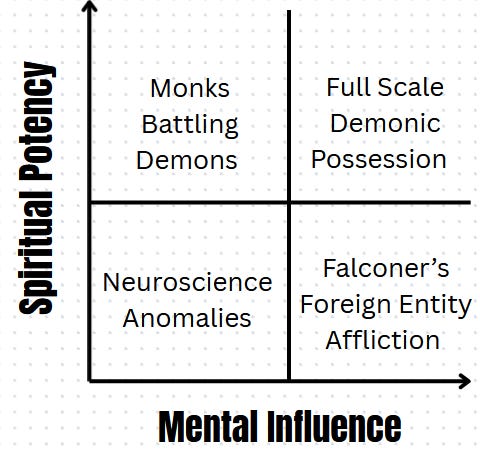
So, for example, in the top left-hand corner of the diagram, a very powerful demon might afflict you with only a rarefied, diluted influence. I think perhaps ancient Christian monks were dealing with this (or the holy people of today). They might be so spiritually pure that they get attacked by very powerful demons, but because of their spiritual purity, that influence is diluted.

In the bottom right-hand corner of the diagram, on the other hand, a very weak demon could afflict you to a large degree. This is what seems to be happening with Robert Falconer’s cases. Through abuse and difficult circumstances, people turn to these entities for comfort almost involuntarily. Or it may happen when someone casts witchcraft spells on you out of resentment or anger — a case in Robert Falconer’s book on IFS and foreign psychic entities. They’re not massive demons; they may even barely be evil, but nevertheless you have become embroiled in their field of influence and they have become enmeshed with you. It may also work through possession from outside.
The bottom left is where the strange neuroscience cases sit. The spiritual influence is minimal, and the degree to which something not you influences you is also minimal. So it’s still basically you, but it doesn’t completely rule out that there could be a presence of something other.
The top right might be cases whereby there is strong spiritual influence and that demonic influence really takes you over to a powerful extent. These are cases of full-on demonic possession, and we start to veer into territory where you might be fully demonically possessed. In order for this to happen, people may need to actively turn to the occult and to rituals to invoke demons.
Horizontal Axis: The Science of Foreign Mental Influence
The physical, highly biological mental axis is where we can do scientific work to try and understand how you can become embroiled with kinds of minds which are not you.
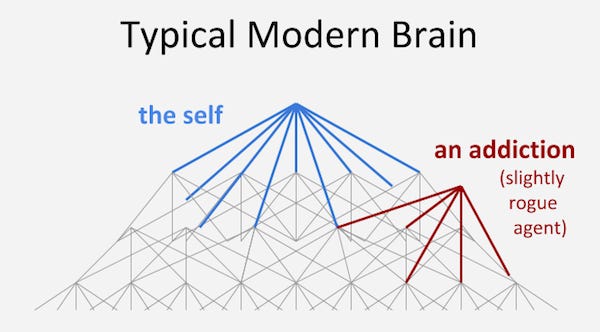
The scientist Michael Levin has great ideas about how to think about thoughts versus thinkers. Are you a stable identity out of which thoughts arise? Or could thoughts themselves have agency over you? For example, could addictive tendencies have a bit of agency of their own? Could that agency, which at first is just a baby part of you, then grow and begin to swallow up the rest of a mind and brain?
Some of my favourite work in this area is by Kevin Simler exploring whether it is a natural part of human cognition to take up the minds of others, and whether the sense of normalcy in which we are ourselves and have our own standalone minds is the exception, not the rule.
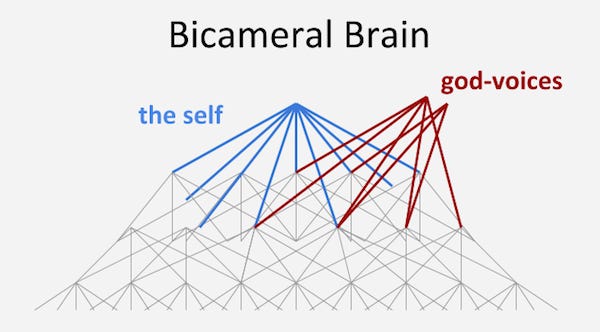
For example, he points to how in ancient times perhaps people had a less strong egoic sense of self, and so it was easier to feel like gods were talking within your mind, or like thoughts didn’t come from you but from somewhere else (he’s exploring Julian Jaynes’s hypothesis in The Origin of Consciousness in the Breakdown of the Bicameral Mind).
He grounds his explorations in the neuroscience of how brains are a place where neurons are constantly battling it out for scarce energetic resources. So perhaps something that isn’t really yourself could come in and actually dominate the typical structure of the ego we designate as being us. It’s still us, still our brains. But neurons don’t have an allegiance to any one single configuration of mind. So perhaps neurons can form cabals with other neurons and slowly but surely train you with the imagery and symbology of another “spirit,” not you, until that takes over your mind.
Indeed, for a modern day example, look at the rise in popularity of tulpamancy in the modern day, whereby there are entire Reddit communities where people try to actively create what are essentially imaginary friends. But are these personalities we can create and train just from us? Or are they really something other?
My sense is that we don’t necessarily create anything in the mind from scratch ourselves. When we start dabbling with creating personalities in our minds, naturally we are going to invoke the “spiritual”. Perhaps what we mean by a spirit is just another disembodied mind, but seen from that mind’s own perspective, rather than from our own human perspective.
The Vertical Axis: Fairies and Spiritual Beings
I’ve kind of assumed that spiritual beings are real and exist. Maybe it’s not scientific to do that. But I also don’t think you just have to accept this stuff on faith. Perhaps there could be genuine theological work done to understand how there could be beings which afflict us but are neither clearly demonic nor clearly angelic, such as seems to be happening in the case of Robert Falconer’s foreign entities.
For example, Jonathan Pageau seems to be interested in fairies. Fairies in ancient Christian mythology are entities who did not fall all the way down from heaven in Lucifer and the third of the angels’ fall. They are not quite demons, but close to them. I often wonder whether in Robert Falconer’s strange cases he’s dealing with fairies.
For example, reading his book it often seems like the entities themselves feel bad about afflicting the patient. Mr. Falconer then sometimes has compassion for such entities. He talks to the entities and finds out they’re often scared of going back to where they came from. That they have kinds of overlords that they need to deal with. Maybe the spirits regret what they’ve done (though I’m not sure what one should do with that information and whether having compassion on them is necessarily correct).
Perhaps there are ranks of demons, and you’re not always dealing with the most vicious of demons, but it’s still something that has to be dealt with and gotten rid of and expelled from the mind.
This is a kind of affliction that on the one hand is not a full demonic possession which requires an exorcist, but on the other hand it’s not just something with an obvious mental illness that has a strictly biological cause.
Conclusion
It’s difficult to write a post like this, since it’s at the intersection of science and spirituality. Perhaps it will simply annoy both the religious types and the scientifically minded. Nevertheless, I think these intermediary cases are super fascinating in how they must stretch the way we think. I’m happy for people to have alternative explanations than me. Please do let me know your thoughts.
Thank you for reading!